A case not really made -- A critical review of Karen Armstrong's "The Case for God: What Religion Really Means"
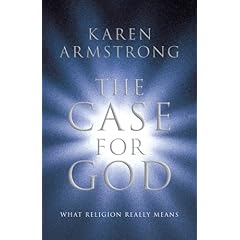
Before I move on to review Karen Armstrong's "The Case for God", I think I should make it clear to you all, especially those who have read Lee Strobel's works, that this book is not akin to the books in Strobel's "The Case for ..." series (incidentally, I have read two books from this series; specifically, "The Case for Christ" and "The Case for Faith"), in that this book was not written as a Christian apologetic.
Changed conceptions
Instead, in this book of hers, Armstrong traces the historical evolution of how concepts/terms such as "God", "religion" and "faith" were understood by people. According to her, ancient conception of these concepts was very different from how we, in today's world, conventionally understand them.
Specifically, Armstrong argues that unlike how we conventionally understand these concepts, these concepts were understood in a significantly less literal/more allegorical and less dogmatic manner.
For example, according to Armstrong, the creation myth found in the Book of Genesis was not, in ancient times, read "as a literal account of the origins of existence". Similarly, "The Eden story is not a historical account" but "an imaginary account of the infancy of the human race".
Also, as described by Armstrong, the word "belief" "originally meant 'loyalty to a person to whom one is bound in promise or duty'", it was only from the seventeenth century onwards that it was "used to describe an intellectual assent to a hypothetical -- and often dubious -- proposition".
And, most importantly of all, in contrast with how we now conventionally understand "God" as being a supernatural being, "God", to the ancient people, was understood as an abstract, ineffable, transcendental Being. Indeed, I suppose "God" was perhaps used in ancient times as a convenient shorthand label for a supposed mystical and transcendental reality [cf. Plato's concept about Ideas/Forms].
As for "religion", it was not understood as being a belief system or social institution but as a form of spiritual exercise through human beings would be able to experience the mystical and transcendental reality mentioned above. As Armstrong would say: religion is not something we believe in but something we do.
This paradigm shift in how these concepts were understood was a consequence of the rise of the scientific mindset and the reaction it caused amongst religious believers.
Science/reason and religion/faith: impossible bedfellows?
It is also Armstrong's argument that science/reason and religion/faith were, in the pre-modern period, not perceived as being antithetical to one another. Instead, it was recognised that each of these served starkly different but equally valid and essential functions required by humankind (here, Armstrong made reference to Stephen Jay Gould's idea of NOMA).
As Armstrong puts it, "Religion was never supposed to provide answers to questions that lay within the reach of human reason. That was the role of logos. Religion's task, closely allied to that of art, was to help us to live creatively, peacefully and even joyously with realities for which there were no easy explanations and problems that we could not solve: mortality, pain, grief, despair, and outrage at the injustice and cruelty of life."
Conversely, "Scientific rationality can tell us why we have cancer; it can even cure us of our disease. But it cannot assuage the terror, disappointment and sorrow that comes with the diagnosis, nor can it help us to die well. That is not within its remit."
However, as was mentioned above, people's conceptions changed during the modern period. Both religious fundamentalists and the New Atheists (a term used by Armstrong to describe individuals such as Richard Dawkins, Sam Harris and Christopher Hitchens) began to insist that their respective ways of understanding the world was the only valid way. With such a viewpoint, both of these camps thus became intolerant of one another and sought to encroach into one another's sphere of expertise.
Return to the past, we must
Hence, based on her opinion that we in the modern period have misunderstood the original true meanings of "God" and "religion", Armstrong proposes that we learn from, if not make a return to, ancient principles and conceptions about these concepts/terms.
Particularly, in line with this project of hers, Armstrong argues that we need to interpret religious teachings in a manner which will inspire compassion, tolerance, peace and goodwill.
An eloquent but unconvincing case
So what do I think about the arguments made by Armstrong?
On the overall, I would say that Armstrong have made several valid, interesting and thought-provoking points in her book. However, there are perhaps a few aspects in which her argument is deficient.
Firstly, with regards to Armstrong's argument that we should make a return to ancient principles and conceptions about "God" and "religion", I cannot help but wonder: is it possible for us to do so?
I am sceptical about the possibility of us making a return to the ancient paradigm because in my opinion, we have perhaps become so entrenched in our current conventional way of viewing "God" and "religion" that it will be most difficult, if not impossible, for us to abandon it to make a return to the ancient paradigm.
One will just need to think about how religion has now become a significant social institution, for example: the Catholic Church, to recognise that it is perhaps overly-idealistic, if not naive, to think that we can simply make a return to the ancient paradigm of religion being a "spiritual exercise".
In addition, although it may indeed be true that our interpretation of "God" and "religion" have departed greatly from the original/ancient interpretation of these terms, this does not necessarily mean that our interpretation is "wrong".
I mean, if I am not wrong, many words have changed their meanings or taken on new meanings over time; would this thus mean that we are using these words "wrongly" and should return to the original meanings of these words?
In fact, Armstrong states in her book that ancient scholars did not approve of people "clinging nervously to the insights of the past". Yet, she seems to contradicts this principle by arguing that we should make a return to the ancient paradigm.
Furthermore, I find it somewhat hypocritical for Armstrong to fault religious fundamentalists and the New Atheists as being intolerant in their insistence that theirs is the only valid way of interpreting religion while she perhaps does the same in her assertion that the viewpoints of religious fundamentalists and the New Atheists are incorrect.
Lastly, while I can agree with Armstrong's argument that religion serves a significant and essential function, I cannot help but wonder if this function can only exclusively be provided by religion. As Armstrong herself has stated, philosophers, poets, musicians and even some scientists have also managed to experience the same feelings which are experienced by the religious. Would this not imply that philosophy, poetry, music and science can and have also been able to serve the same function that Armstrong's interpretation of religion has? If so, why should we cling onto "religion" as interpreted by Armstrong?
Hence, in conclusion, I would say that Armstrong's case, while eloquent and intelligent, is perhaps ultimately unconvincing.
Changed conceptions
Instead, in this book of hers, Armstrong traces the historical evolution of how concepts/terms such as "God", "religion" and "faith" were understood by people. According to her, ancient conception of these concepts was very different from how we, in today's world, conventionally understand them.
Specifically, Armstrong argues that unlike how we conventionally understand these concepts, these concepts were understood in a significantly less literal/more allegorical and less dogmatic manner.
For example, according to Armstrong, the creation myth found in the Book of Genesis was not, in ancient times, read "as a literal account of the origins of existence". Similarly, "The Eden story is not a historical account" but "an imaginary account of the infancy of the human race".
Also, as described by Armstrong, the word "belief" "originally meant 'loyalty to a person to whom one is bound in promise or duty'", it was only from the seventeenth century onwards that it was "used to describe an intellectual assent to a hypothetical -- and often dubious -- proposition".
And, most importantly of all, in contrast with how we now conventionally understand "God" as being a supernatural being, "God", to the ancient people, was understood as an abstract, ineffable, transcendental Being. Indeed, I suppose "God" was perhaps used in ancient times as a convenient shorthand label for a supposed mystical and transcendental reality [cf. Plato's concept about Ideas/Forms].
As for "religion", it was not understood as being a belief system or social institution but as a form of spiritual exercise through human beings would be able to experience the mystical and transcendental reality mentioned above. As Armstrong would say: religion is not something we believe in but something we do.
This paradigm shift in how these concepts were understood was a consequence of the rise of the scientific mindset and the reaction it caused amongst religious believers.
Science/reason and religion/faith: impossible bedfellows?
It is also Armstrong's argument that science/reason and religion/faith were, in the pre-modern period, not perceived as being antithetical to one another. Instead, it was recognised that each of these served starkly different but equally valid and essential functions required by humankind (here, Armstrong made reference to Stephen Jay Gould's idea of NOMA).
As Armstrong puts it, "Religion was never supposed to provide answers to questions that lay within the reach of human reason. That was the role of logos. Religion's task, closely allied to that of art, was to help us to live creatively, peacefully and even joyously with realities for which there were no easy explanations and problems that we could not solve: mortality, pain, grief, despair, and outrage at the injustice and cruelty of life."
Conversely, "Scientific rationality can tell us why we have cancer; it can even cure us of our disease. But it cannot assuage the terror, disappointment and sorrow that comes with the diagnosis, nor can it help us to die well. That is not within its remit."
However, as was mentioned above, people's conceptions changed during the modern period. Both religious fundamentalists and the New Atheists (a term used by Armstrong to describe individuals such as Richard Dawkins, Sam Harris and Christopher Hitchens) began to insist that their respective ways of understanding the world was the only valid way. With such a viewpoint, both of these camps thus became intolerant of one another and sought to encroach into one another's sphere of expertise.
Return to the past, we must
Hence, based on her opinion that we in the modern period have misunderstood the original true meanings of "God" and "religion", Armstrong proposes that we learn from, if not make a return to, ancient principles and conceptions about these concepts/terms.
Particularly, in line with this project of hers, Armstrong argues that we need to interpret religious teachings in a manner which will inspire compassion, tolerance, peace and goodwill.
An eloquent but unconvincing case
So what do I think about the arguments made by Armstrong?
On the overall, I would say that Armstrong have made several valid, interesting and thought-provoking points in her book. However, there are perhaps a few aspects in which her argument is deficient.
Firstly, with regards to Armstrong's argument that we should make a return to ancient principles and conceptions about "God" and "religion", I cannot help but wonder: is it possible for us to do so?
I am sceptical about the possibility of us making a return to the ancient paradigm because in my opinion, we have perhaps become so entrenched in our current conventional way of viewing "God" and "religion" that it will be most difficult, if not impossible, for us to abandon it to make a return to the ancient paradigm.
One will just need to think about how religion has now become a significant social institution, for example: the Catholic Church, to recognise that it is perhaps overly-idealistic, if not naive, to think that we can simply make a return to the ancient paradigm of religion being a "spiritual exercise".
In addition, although it may indeed be true that our interpretation of "God" and "religion" have departed greatly from the original/ancient interpretation of these terms, this does not necessarily mean that our interpretation is "wrong".
I mean, if I am not wrong, many words have changed their meanings or taken on new meanings over time; would this thus mean that we are using these words "wrongly" and should return to the original meanings of these words?
In fact, Armstrong states in her book that ancient scholars did not approve of people "clinging nervously to the insights of the past". Yet, she seems to contradicts this principle by arguing that we should make a return to the ancient paradigm.
Furthermore, I find it somewhat hypocritical for Armstrong to fault religious fundamentalists and the New Atheists as being intolerant in their insistence that theirs is the only valid way of interpreting religion while she perhaps does the same in her assertion that the viewpoints of religious fundamentalists and the New Atheists are incorrect.
Lastly, while I can agree with Armstrong's argument that religion serves a significant and essential function, I cannot help but wonder if this function can only exclusively be provided by religion. As Armstrong herself has stated, philosophers, poets, musicians and even some scientists have also managed to experience the same feelings which are experienced by the religious. Would this not imply that philosophy, poetry, music and science can and have also been able to serve the same function that Armstrong's interpretation of religion has? If so, why should we cling onto "religion" as interpreted by Armstrong?
Hence, in conclusion, I would say that Armstrong's case, while eloquent and intelligent, is perhaps ultimately unconvincing.



 Posts
Posts